

Who you can hire
The framework you can staff in Europe for the next two years beats the one that benchmarks a few percent faster today. JavaScript talent is everywhere.
Mobile
In short: Choose React Native if your team knows JavaScript or React, you want the largest talent pool, and you may share code with a web app. Choose Flutter for pixel identical UI and top tier animation if you are comfortable with Dart. For most JavaScript first teams and European businesses hiring locally, React Native is the pragmatic default.
For most teams the answer is React Native, because it shares a language and components with your web app, hires from the deepest talent pool, and ships a genuinely native feel. Pick Flutter only when your product is unusually animation heavy and you are happy to commit to Dart. Both frameworks build real iOS and Android apps from one codebase, so the choice is rarely about raw capability. It is about your team, your hiring market, and how much custom UI you actually need.
Typical saving of one cross platform build versus two separate native builds
of enterprise mobile teams build on React Native (Statista, 2025)
Shared across iOS and Android, with code reuse into web when you stay on React Native
Both React Native and Flutter ship apps that feel native on iOS and Android from a single codebase. The decision is rarely about which one can technically do the job. It is about the language your team already speaks, the engineers you can hire in Europe, and how much fully custom UI your product demands.
Rule of thumb
If your team already writes JavaScript or React, default to React Native. If you are starting fresh and your product is unusually animation heavy, evaluate Flutter on its merits.
The two frameworks differ most in the language they use, how they render the screen, and how easily they share code with the web. The table below sums up the factors that actually move a decision.
| Factor | React Native | Flutter |
|---|---|---|
| Language | JavaScript and TypeScript | Dart |
| UI rendering | Native platform components | Custom engine that paints every pixel |
| Performance | Excellent for most apps, near native | Excellent, strong for heavy animation |
| Ecosystem | Vast, shares the React and npm world | Growing fast, well curated packages |
| Hiring in Europe | Very large pool, easy to staff | Smaller but growing pool |
| Web code sharing | High with React and Next.js | Limited in practice |
| When to choose | JavaScript first teams, MVPs, web plus mobile | Highly custom UI and animation led products |
The framework you can staff in Europe for the next two years beats the one that benchmarks a few percent faster today. JavaScript talent is everywhere.
React Native shares components, types and logic with a React or Next.js web app. One team, one mental model, far less duplicated work.
Standard product screens look great in either. If your app is animation led or needs a bespoke design system on every pixel, Flutter earns a closer look.
Both support fast iteration and over the air updates for the JavaScript layer in React Native. A familiar stack ships an MVP sooner.
If you have written React for the web, this will feel immediately familiar. You get components, hooks and a declarative UI, mapped to native primitives instead of HTML.
import { useState } from 'react';
import { View, Text, Pressable, StyleSheet } from 'react-native';

export function Counter() {
  const [count, setCount] = useState(0);

  return (
    <View style={styles.row}>
      <Text style={styles.label}>Count: {count}</Text>
      <Pressable style={styles.btn} onPress={() => setCount((c) => c + 1)}>
        <Text style={styles.btnText}>Increment</Text>
      </Pressable>
    </View>
  );
}

const styles = StyleSheet.create({
  row: { flexDirection: 'row', alignItems: 'center', gap: 12 },
  label: { fontSize: 16, fontWeight: '600' },
  btn: { backgroundColor: '#2563eb', paddingHorizontal: 16, paddingVertical: 8, borderRadius: 8 },
  btnText: { color: 'white', fontWeight: '600' },
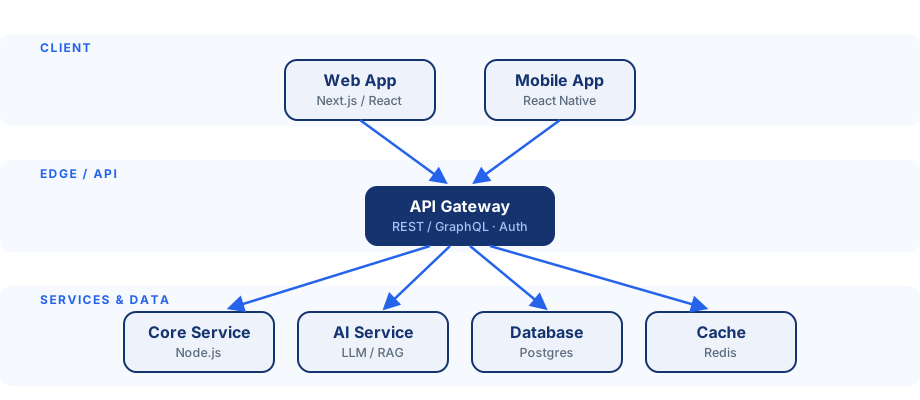
});Whichever framework you pick, the mobile client is only one tier. A production app shares an API and services with your web app, which is exactly why sharing a stack pays off. With React Native plus React and Next.js, the same engineers move across mobile and web without relearning everything.
One cross platform codebase commonly saves 25 to 45 percent versus building separate native apps for iOS and Android. You write features once, test once, and ship to both stores. With React Native you can push that further by reusing logic and components from a web app, so the savings compound across your whole product.
Why this matters in Europe right now
A shared codebase and an easy to hire stack let a small team ship to both platforms without doubling headcount, which is usually the real constraint rather than the framework itself.
We build most cross platform apps in React Native. The JavaScript talent pool is deep, it shares a stack with our React and Next.js web work, and it ships fast without sacrificing native feel. We reach for Flutter only when a project is unusually UI or animation heavy and the team is ready to invest in Dart.
Pick the framework your team can hire for and maintain in two years, not the one that benchmarks three percent faster today.— DevzAura Mobile Engineering
Work with senior, compliance aware engineers and transparent pricing. We help you pick the right framework and ship it on one codebase shared with your web app.
Want this reviewed on your codebase?
Bring the specifics. We will tell you what actually applies to your stack and what does not.
Need help with React Native Development?
Explore React Native DevelopmentKeep Reading
11 min read
In 2026, expect to budget roughly $15k for a simple internal tool, €28k to €75k for an MVP, $80k to $200k for a SaaS platform, and $200k or more for an enterprise build. The real number tracks scope, integrations, engineer seniority, and compliance, not whichever Europe vendor gives you the vaguest quote.
12 min read
Building fintech in the EU or UK regime is not a feature you bolt on at the end. It is an architecture decision you make on day one. Get data residency, encryption, auditability, and KYC and AML right early, and compliance becomes a moat instead of a blocker.
FAQ
Book a free consultation with our engineers.